Total Pageviews

Sunday, May 27, 2012


Yentha Travel: Sikkim Sojourn - Part 2
Following the Madhusudan family on their Sikkim Sojourn.
On May 02, 2012

 Yentha Travel - Exclusive travelogues brought to you  in association with Kerala Travels Interserve.


We arrived at our home stay at Yangsum farm by 6pm just after dusk. Thendup Tashi Bhutia, our gracious host, greeted us at the farmhouse, which was built in 1833 and remodeled in 1966. Thendup who hails from the Tsechu Tharpa family manages the 60 acre farm with his wife. They have a lovely six month old daughter Mingur Yangden  (meaning “forever lucky”). Thendup has a famous first cousin, Baichung Bhutia, India’s most famous footballer.
The organic farm consists of open mixed forests of pine, Himalayan alder, chestnut, magnolia, rhododendrons, cherry and several others. Cardamom, avocados, oranges, bananas, pears, apricots, mangoes, cauliflower, cabbage, tomatoes and peas are also grown. During the cultivating season, maize, paddy, millet, potatoes, ginger, turmeric and sweet potatoes are produced.
Arundhathi in front of the cottage

We had a couple of hours rest before dinnerin the beautiful cottage, which was furnished in the customary Sikkimese style. Dinner was served in a traditionally styled room, which had a whiff of the exotic and the whimsical. The room was full of family photographs, albums, porcelain ware, dolls and toys. My daughter jumped out of my arms as soon as she saw the room and it was like letting loose a cat among the pigeons. Her immediate fancy was a pair of stuffed bears-mother & baby. She ensured that the two were served prior to having anything!


After the tiresome road trip from Gangtok, we woke up long after daybreak on 18th. We had a lovely outdoor breakfast facing Kanchenjunga. Thendup took us on a nice walk shortly afterwards. The countryside was beautiful. We saw a lot of roadwork happening, providing employment to the rural folks. The Government of India has started a new programme, namely the Prime Minister’s Gramodya Sadak Yojana for rural connectivity. Under this programme the Government has constructed several footpaths, suspension footbridges, steel footbridges, RCC footbridges, log bridges etc. 


Thendup pointing to Bahichung Bhutia’s village

The government has also focused on providing financial assistance to the rural poor for the construction of houses We saw a long stretch of wall in one of the villages which had intricate paintings. Thendup told us that these were ancient prayer walls. We also saw some old heritage houses build in traditional style on the way.


Momos
Soon our legs were giving up under us and we returned to the farm for lunch. The afternoon siesta extended to well past sunset. And after waking up, we went straight for dinner! We were delightfully surprised with the menu, which consisted of the local cuisine. It was a heady mix of a clear soup called Thukpa and steamed dumplings or Momos, as they are popularly known here. Momos were served with a fiery Sikkimese tomato chutney. My wife was keen to try a hand at making Momos and we got the recipe. (This will be featured in this week’s Food Corner on Yentha)
We woke up at dawn the next day to show our daughter Arundathi, how cows are milked. Draped in blankets we looked like 3 ghosts as we made our way across the farm to the cowshed.

Arundhati also played with the goats, ducks and hens in the pen nearby. After breakfast, we started off on a full day of sightseeing. We had packed a nice picnic lunch and our driver took us through a scenic route, where we stopped at every waterfall on the way!


Picnic lunch at helipad

Our first stop was at the helipad at Pelling, a quite village and our driver couldn’t have selected a better spot for our picnic lunch. We had spectacular views of Mount Kanchendzonga, the Guardian Deity of Sikkim.  Situated at an altitude of about 2105 mtrs/ 6840 ft., Pelling was originally known as Pemalingpa. The name Pemalingpa is derived from the Pemalingpa monastery.

There are many beautiful waterfalls situated amidst the green forests near Pelling.

After lunch at the helipad, we proceeded towards Pemayangtse Monastery. It is the most important monastery of the Nyingmapa order and was built in the late seventeenth century by Lama Lhatsum Chenpo, one of the most revered Lamas. He had performed the consecration ceremony of the first Chogyal (religious monarch) of Sikkim andthis monastery, considered as one of the premier monasteries in the state had been entrusted with the task of performing all the religious functions of the erstwhile monarch. The monastery houses numerous religious idols & other objects of worship, most of which are priceless because of their antiquity. Inside the monastery, on the top floor, there is a wooden structure depicting the Maha Guru’s heavenly palace (Sang-tok-palri), a masterpiece created by the late Dungzin Rimpoche.


Pemayangtse Monastery

Our final destination for the day was the Rabdentse ruins. Rabdentse was the second capital of Sikkim & was established in the late seventeenth century by the second Chogyal of Sikkim. It was abandoned towards the end of the eighteenth century because of the threat posed by Nepal and the capital was shifted to Tumlong. The Rabdentse Palace lies in ruins now. We had to trek about 2 kms from the main road near Pemayangtse monastery through a nature reserve to reach it. The reserve isa sanctuary for 106 species of birds like the Steppe eagle, Chestnut-crowned Warbler, Rufous-capped Babbler, Black-eared Shrike Babbler and Dark-breasted Rosefinch. 

Rabdentse

The ruins are now being preserved by the Archaeological Survey of India and have been declared as a monument. Partly restored, one can now visit the king’s bedroom, assembly hall kitchen, public courtyard the palace guards’ room etc.

We returned to our farm by 5 in the evening to cherish our final hours in Sikkim. We were leaving the next morning back to the urban chaos of Bangalore. So we made the best of the evening by soaking in the ambience over a bonfire.


Thinking back about the journey, I can only say that it was one incredible holiday; one of the best we have ever had.

Madhusudan Narayanan is an Analytics professional based out of Bangalore. He is a keen wildlife enthusiast and nature tourist. He has hiked up the million year’s old Briksdal glacier in Norway, located a few hundred miles south of the Arctic Circle. His favourite holiday destination is Queenstown in New Zealand. Closer home, his favorites are Periyar Wild Life Sanctuary, Vedanthangal bird sanctuary, Kabini River basin, the Nilgiri biosphere and Matheran.

Yentha Travel: Sikkim Sojourn - Part 1
First part of an extensive tour of a state of India that doesn’t often find a place on the itinerary of those of us down south | By Madhusudan Narayanan
On May 01, 2012

 Yentha Travel - Exclusive travelogues brought to you  in association with Kerala Travels Interserve.

Our family went on a weeklong holiday to Sikkim and it turned out to be one of our best vacations ever. Since we were travelling all the way from Bangalore to Calcutta for a wedding, we decided to explore the Northeast. We zeroed in on Sikkim. After the wedding reception, we took the Darjeeling Mail to New Jalpaiguri station. New Jalpaiguri which means olives in Bengali, is the sister city of Siliguri and connects Darjeeling to the plains of West Bengal through the world famous Darjeeling Himalayan Railways. After a short break at Siliguri where we had our breakfast, we commenced our 4 hour drive to Gangtok on National Highway 31A.

 Kanchenjunga, the guardian deity of Sikkim

We meandered around the scenic hills and over the serene looking Teesta River and finally arrived at Gangtok for lunch.  As we checked into our hotel- Hidden Forest Retreat, we realised that the name did justice to the place. It was spread over three acres of lush green garden with all kinds of trees, bamboos, ferns, flowers, shrubs, lilies and orchids with a variety of birds and butterflies making this their home. The retreat is an extension of the flower nursery, which specializes in tissue culture and breeding orchids, lilies and azaleas for over two decades. Through the entire retreat runs a network of stone paved pathways that lead up and down the hill into the dense forest and orchid nursery.


Sikkim, which is one of the smallest states in India, is famous for Kanchenjunga, the third highest mountain in the world at 8,586m.  Rising 300m above the Indian plains, the state borders the edge of the Tibetan Plateau on its north and Nepal on its east. Historically a Buddhist kingdom, Sikkim has close links with Tibet. It is  home to over 250 monasteries of mostly the Nyingma-pa sect. Sikkim is rich in flora and fauna. About 450 varieties of orchids, over 600 species of butterflies, 500 species of birds along with red pandas, snow leopards dot the length and breadth of Sikkim. The largest collection can be seen at the Kanchenjunga National Park. In fact, ornithology tourism is also gaining in prominence in Sikkim.


After a sumptuous lunch, we took a short drive around Gangtok. The capital of Sikkim is also the largest city in the state. It’s a melting pot of different cultures. Situated at an altitude of 1,700 m above sea level, Gangtok lies on the eastern side of Sikkim and is the headquarters of the eastern district. Being on the lower Himalayas, it offers some breathtaking views of Kanchenjunga.

Our first destination was Do-Drul Chorten. Built in 1945 by Trulshi Rimpoche, Do-drul Chorten is one of the most important attractions in Gangtok. The beautiful milky white stupa has a revered golden Shikhara containing 108 prayer wheels, which makes it a highly revered religious place. Do-drul Chorten contains the complete mandala set of Dorjee Phurba (Bajra Kilaya), a set of Kan-gyur relics (holy books), and many other holy objects including the complete Zung (mantras). Two huge statues of Guru Rimpoche (Guru Padamsambhava) adorn the side of Do-drul Chorten further adding to the beauty of the stupa.

Madhusudan near Tsomgo lake

Next, we proceeded towards the flower exhibition centre. A variety of multi-colored orchids, seasonal flowers as well as bonsai were on display. The entire exhibition is in a well-planned, enclosed greenhouse and is an excellent place to observe the flora or take photos. The flower shows follow the seasons and focus on the specific flowers that flourish at that time. It was just 6 and already dark! So we decided to skip the other attractions and went back to our hidden forest retreat to call it a day.
Do DrulChorten

We woke up at 6 in the morning the next day, to get ready for a visit we had been anticipating for quite a while. We had submitted our identity proofs and photographs a week in advance to get a permit to visit this place. We were headed for the famed Tsomgo Lake at a height of 12,000 feet and on the ancient silk route! Tsomgo lake is situated 35 km  from Gangtok, on the Gangtok-Nathula highway which forms a part of the old trade route from India to China. Before 1962, caravans of mules carrying goods used to ply this route. The stretch of the route just below Karponang, 15  km from Gangtok was particularly dangerous. Its steepness resulted in many mules slipping to their death into the ravine below. During  winter the lake freezes over. Back in the old days, Lamas forecasted the future studying the colour of the water of the lake. If the water of the lake had a dark tinge, it foreshadowed a year of trouble and unrest in the state.

The journey to the lake was very scenic through the snow-capped mountains. My 3-year old daughter squealed with delight as soon as we reached our destination. As I turned around to find out what had attracted her, I spotted a pair of yaks! A couple of Sikkimese Sherpas approached us and offered a ride on the yaks around the lake. My daughter and I rode ‘Shamu’, while my wife got a ride from ‘Hritik’! The Sherpa had indeed named his yak after the famed Bollywood actor after watching “Kaho Na Pyar Hai”. Hritik has been doing the rounds of the lake for the past 9 years after a year’s training!

Walking on snow

After getting back to our hotel, we had a quick lunch and proceeded towards Yangsum, a village in West Sikkim and our abode for the rest of the week. The 135 km ride took us 5 hours to cover. We took a break at Jorthang, a small town located in a plain landscape of South Sikkim. In fact,we were told that it was the only town with a plain landscape in the whole of Sikkim. The town is known for its annual Maghey Sakrati, the important fair festival of the Nepali ethnic community of Sikkim. Our next halt was Rinchengpong, a small village in the hills of West Sikkim, 6,000 ft above sea level. This village had played host to Rabindranath Tagore, no less, for a couple of days in the 1920s. Rabindranath Smriti Van, the house where the poet stayed and enjoyed the scenic view of the Himalayas, is just 2 km from Rinchenpong bazaar. It is a major tourist draw and has been maintained well.

Madhu and his family

About 3 km from Rinchenpong bazaar is the Resum monastery. Located at the junction of three hills, this place of worship was built almost two centuries ago by a local Lepcha (original inhabitant) and is still under private supervision. The place offers an excellent view of the mountains, especially of the sunrise from behind the Kanchenjunga. A 30-minute walk through the jungle will take you to a popular tourist attraction of Rinchenpong — The Heritage House. The stone and wood construction, which came up in 1860, was used to host the British governor, a regular visitor. In the semi-darkness, the interiors reveal multi-cultural influences, including wall paintings and wood carvings of the traditional Tibetan school. One of the oldest monasteries of Sikkim, the Gey-Sanga-Yangtze Gumpha, is also a walk away from the main bazaar. It houses a statue of Ati Buddha with a lady embracing him. This unique religious icon of the Nyingma sect of tantrik Buddhism symbolizes the power of lust.

On that note we take a break from the narrative. Watch this space tomorrow for more about a less known region of our country ... (to be continued)


Madhusudan Narayanan is an Analytics professional based out of Bangalore. He is a keen wildlife enthusiast and nature tourist. He has hiked up the million year’s old Briksdal glacier in Norway, located a few hundred miles south of the Arctic Circle. His favourite holiday destination is Queenstown in New Zealand. Closer home, his favorites are Periyar Wild Life Sanctuary, Vedanthangal bird sanctuary, Kabini River basin, the Nilgiri biosphere and Matheran.

State of Paradox‘India Becoming,’ by Akash Kapur

By GEOFFREY C. WARD
source:India Ink


“India” and “change” were once virtual antonyms: old India hands returned again and again in large part because the subcontinent was so dependably different from the West. But since 1991, when a financial crisis forced India’s government to devalue the rupee, lower import barriers and relax controls on private investment, things have nearly reversed themselves. As the journalist Akash Kapur demonstrates in his lucid, balanced new book, “India Becoming,” his homeland now seems almost synonymous with change.

Kapur is especially qualified to assess the contrasts and contradictions all that change has brought. The son of an American mother and an Indian father, he was raised on the outskirts of Auroville, a utopian international community in the southern state of Tamil Nadu. Sent away to boarding school in the United States at 16, he studied at Harvard and Oxford, then returned to South India 12 years later, in 2003. His lively “Letter From India” appeared for several years in The International Herald Tribune and the online edition of The New York Times.

At first, he was dazzled. While the friends he’d left behind in America fretted about holding on to their jobs, it seemed to him that every other young person he met in India was eager to quit his or hers to become an entrepreneur. The Indian economy was then growing at about 8 percent, led by the expanding service and I.T. industries, and the country’s mood was “giddy, exuberant,” “ardently capitalist,” and aspirational. “For the first time — the first time in my life, but arguably in India’s history, too,” he writes, “people dared to imagine an existence for themselves that was unburdened by the past and tradition. India, I felt, had started to dream.”

But, over time, as he settled permanently back into the countryside, married and had two sons, he found himself at least as appalled by the new India as he was admiring. For all the restaurants and yoga centers, colleges and gated communities that now lined the newly blacktopped country roads he’d known as a boy — and despite two decades of new money and new opportunities — poverty stubbornly persists. More than 300 million of India’s 1.2 billion people still live on less than a dollar a day, he tells us; more people have cellphones than access to a toilet. And heedless growth steadily despoils the environment; nearly half of India’s land is eroded; at least 70 percent of its surface water is polluted and, according to one recent study, India’s air is now the most toxic on earth — a fact vividly brought home to Kapur and his family one spring when the smoky reek of thousands of tons of smoldering untreated garbage dumped outside the town of Pondicherry seeped into his home and sickened one of his ­children.

His conclusions about all this are rarely surprising and often reiterative: we are told too many times that change comes at a cost; that “unrelenting optimism” is “delusional”; that “India could often feel like two nations.” But Kapur is determinedly fair-minded, neither an apologist nor a scold, and he is a wonderfully empathetic listener, willing patiently to visit and revisit a large cast of men and women over several years to learn how they are benefiting from — and being battered by — the change going on all around them.

He is on familiar ground when following the careers of middle-class young people who’ve left behind the small towns and ancient customs that had given shape to their lives in order to build wholly new ones in the brand-new big-city world of shopping malls and office towers. Hari, a gay I.T. worker in Chennai, finally comes out to his friends but can’t bring himself to confide in his parents. Selvi, a call-­center worker in the same city, disappointed to find that most of the Americans with whom she speaks each night are “rude and also quite stupid,” suddenly finds herself accused by neighbors and relatives of being a loose woman simply because one of her flatmates is found to have been involved in a love affair. But Kapur is at his best when writing about what is happening out in the country, where he has chosen to live. Gandhi once said the soul of India was to be found in its villages. “That was still true when I was growing up,” Kapur notes, “when the pastoral world around me — the hand plows, the windmills, the bicycles, the catamarans and bullock carts — contained all the charm and simplicity (and the backwardness) of the nation.” Despite the movement of millions of people from the land in recent years, 7 out of 10 Indians still live in rural areas, but their world, too, is becoming almost unrecognizable.


INDIA BECOMING

A Portrait of Life in Modern India
By Akash Kapur
292 pp. Riverhead Books. $26.95.

Kapur’s guide to most of what’s happening there is a middle-aged landowner named Sathy, whose warrior clan once controlled the village of Molasur (along with 75 surrounding communities), but who cannot now persuade even his citified wife to live with him in the country. For him, everything seems upside down. His once-rich fields have been poisoned by chemical fertilizers. His neighbors are selling off their land to developers, relying on shopkeeping or remittances sent home by sons in the city to keep going.

Caste is loosening its grip. Sathy introduces Kapur to a Dalit (untouchable) named Das, still unwilling to enter Sathy’s house out of respect for older members of the family, who has nonetheless made himself prosperous by buying up 50 acres of farmland, dividing it into 1,700 plots and selling all of them off within four months to newly prosperous young couples from Chennai, looking for second homes. He has named his colony Kingmaker City.
Sathy has more or less made his peace with the fact that the people of his hometown are no longer satisfied to have their children lead the truncated lives they and their ancestors have always led; he marvels that his own niece and Das’s son now study in the same school, something that would have been unthinkable just a few years ago. But “if all the farms are gone,” he asks, “then who will feed all these fancy people?” He has a point: Indian agricultural production has slowed; food prices and malnourishment are both on the rise.
Villages like Molasur have become, as Kapur puts it, “wounded places,” no longer predominantly agricultural, not yet really urban. “People are lost,” Sathy says. “They no longer know who they are. All the money has taken them away from themselves.” The rapid infusion of cash combined with the collapse of old hierarchies has led to lawlessness: thuggery, kidnappings, bombings, clashes between castes. When Kapur’s car accidentally injures a boy, an angry mob collects around the police station where he and his driver have gone to report the incident. The police officers seem unable or unwilling to intervene. Kapur phones Sathy, who, still cloaked in a remnant of his ancestors’ feudal power, hurries to the site and manages to calm things down. Had he not been able to do so, Kapur and his driver might have been lynched.
“I had left America because I felt that the country was in many ways at a standstill,” Kapur writes. “I moved to India in search of action. I wanted to feel alive, and I suppose I got a little bit more than I had bargained for. India was undeniably — sometimes terrifyingly — alive. The country was an adventure. On good days, the dust and chaos and danger could seem part of the adventure; they were invigorating. On bad days, I now decided, I would remember the good days.” For Indians and Indophiles alike, that is very good advice.
Geoffrey C. Ward’s latest book is “A Disposition to Be Rich,” about his larcenous forebear, Ferdinand Ward. He is at work on a book about the partition of India


Despite the lure of the shiny metal, statistics show that gold has outperformed returns from equities over a 5 year period only once in the past 3 decades. Hence, while gold should have a well deserved place in the long term portfolio for its inflation hedging properties, one cannot deny the importance of equities, which depending upon one's risk appetite must be a much larger proportion.


Data source: HDFC Mutual Fund sOURCE:EQUITYMASTER


K Yhome: Myanmar and India - a bridge, and a gateway to the East

Building an enduring relationship with Myanmar will be difficult. But there are some things Dr Singh can do to make it easier

K Yhome / May 27, 2012, 00:55 IST


Myanmar has witnessed dramatic developments in the recent past as the country moves towards a more open political system and re-engages the international community after long years of isolation. These developments have been taking place alongside rapidly changing strategic and economic dynamics in the region. It is in this context that Prime Minister Manmohan Singh’s visit to Myanmar assumes great significance.

In the past decade or so, India’s Myanmar policy has been driven largely by its security and economic considerations. However, the engagement has at least laid the ground for the two neighbours to take their relationship to a higher level. This is in spite of the fact that the political stalemate in Myanmar, between the military regime and pro-democracy movements, coupled with New Delhi’s own sluggish policy implementation and lack of coordination, have impeded the growth of the relationship.

India wants to increase its role and presence in Southeast Asia and beyond. The prime minister’s visit to Myanmar will be seen as part of this effort, within the evolving regional geopolitics, as Myanmar tries to rebalance its external engagements. New Delhi would want to use the visit to reaffirm its willingness to strengthen the relationship with its eastern neighbour, and with the hope that Myanmar both becomes the bridge and acts as a gateway in reaching the East.

Myanmar, meanwhile, will want to see the high-profile visit as a re-affirmation of its reforms, and will hope that the strengthening of ties with the region’s major player will enhance its profile. It aspires to regain its historical place as a regional powerhouse. Naypyidaw will, of course, seek development assistance from New Delhi as it plays catch-up with its neighbours.

Even as the ongoing political transition in Myanmar has made progress under President Thein Sein, the country still faces daunting challenges on several fronts. It remains one of the poorest nations in the region despite being endowed with rich natural resources. Long years of economic mismanagement and military rule have had disastrous consequences, and it will take years for the country to build the capacity it requires. In fact it is here that India’s role and support could play a critical role.

Thus India needs to define its role in Myanmar; and this visit should be used to chart out a long-term plan for enduring cooperation and mutual benefits. The focus of the visit needs to be on creating the ground for strengthening and broad-basing engagement with all the political players in Myanmar; deepening economic ties; and increasing the connectivity between two countries.

Prime Manmohan Singh’s meeting with Aung San Suu Kyi will, of course, send a strong message to her party, the National League for Democracy (NLD), and other pro-democracy parties that India supports the values they have long struggled for. As India engages Suu Kyi and the NLD, it is important that India also build strong ties with the military-backed ruling party, the Union Solidarity and Development Party.

Equally important is building a bridge to Myanmar’s many ethnic political parties — particularly those from the states bordering India. These could play a critical role in dealing with border issues — whether these are related to connectivity, to security, or to infrastructure, trade and investment. More importantly, sharing India’s parliamentary and democratic experiences with Myanmar’s political parties could go a long way in strengthening Myanmar’s nascent democracy.

India and Myanmar have several common social, economic and security issues along their shared border. New Delhi and Naypyidaw are aware that in dealing with these issues, they need each others’ help. Working out a common strategy for development of their border regions will serve well in resolving some of the long-standing ethnic unrest on both sides of the border, as well as other border-related security issues. Increased connectivity to boost economic activities in the border regions will be central to this effort.

For both New Delhi and Naypyidaw, economic development that respects local sensitivities and benefits the local population of India’s Northeast and Myanmar’s Northwestern region are the only answer to resolve the decades-old armed violence that has characterised the two regions. Ethnic communities along the India-Myanmar border have long been seen as a security problem; little, however, has been done by both powers to change this, and efforts to make them key stakeholders in the bilateral relationship have been negligible. This must change.

India needs to focus on its strengths while dealing with Myanmar. Two areas where India can, perhaps, make the biggest impact are the health and education sectors. Indian pharmaceuticals companies have already created a strong presence for themselves in Myanmar, dominating the market with a share of over 40 per cent. India is already involved in building hospitals in Myanmar, and these efforts needs to be expanded by involving the Indian private sector.

Despite the rich traditional and cultural ties between the two countries through history, the present-day presence of each in the popular imagination of the other is dismally low. There is an urgent need to encourage people-to-people contacts. India has several “soft power” advantages that could be leveraged to increase its image in Myanmar. Bodh Gaya and other Buddhist shrines in India could be used to attract Burmese visitors. And Indian educational institutions are yet another area where India can project its image. To this end, offering scholarships to Burmese students to study in Indian universities and technical institutes such as information technology and computer science will ensure a long-term relationship with Myanmar’s younger generations. It may be noted that Aung San Suu Kyi studied and lived in India in the mid-1960s and late 1980s.

As immediate neighbours, sharing long land and maritime boundaries, India and Myanmar have little choice but to engage each other closely. Such engagement, particularly after a long spell of strategic distance, needs understanding of each other’s social and economic interests, and respect for each other’s political and strategic concerns. Prime Minister Manmohan Singh’s visit will be considered crucial by historians, if he succeeds in laying a strong foundation for an enduring relationship between India and its most distant neighbour.


--------------------------------------------------------------------------------


The writer is at the Observer Research Foundation, New Delhi

Saturday, May 26, 2012


It’s my pet theory that you have never really explored a new destination till you’ve seen its market. It was with this in mind that I set off to the floor above the local taxi stand in Gangtok. Extreme pressure on real estate and not much in the way of flat land means that Gangtok has many examples of unlikely business “tie-ups”: The loan-disbursing department of the state government shares space with a popular restaurant; an upmarket curio store doubles up as a cyber café and every cigarette stall does roaring business in car-mirror danglers.
Fiery: The dallae khursani is consumed fresh, not dried.


So it was no surprise that the city’s vegetable market was located at the shared taxi stand (as distinct from the outstation taxi terminus). And what a treasure trove the market was! The flaming scarlet cherry-like objects were the tear-inducing cherry peppers, one of the hottest chillies of the region, though they pale in comparison to the bhut jholokia of Nagaland. Dallae khursani, as the fiery devils are called, are only sold and consumed fresh — never dried. If you don’t think you’ll be able to make it to the market again soon, you can buy dallae chutney, sold in plastic containers in multiples of 100g.
There are mushrooms on sale that look like enoki but are not, a vegetable that resembles asparagus spears but is not, ferns, nettles, dried and fresh yak cheese, bamboo shoots and fermented soya beans and an intriguing vegetable that the vegetable seller assures me is “sweet karela”.
There are three varieties of tiny dried fish, though God knows that Sikkim is far off from any sea; loads of common vegetables such as gourd, okra and tomato, even spices such as cumin, coriander seeds and panchphoran in deference to the tourists, many of whom are from West Bengal.
The strangest thing is that in spite of a thriving local cuisine, all you get in restaurants (besides shahi paneer and mutton korma) are momos and thukpa. Had I not buttonholed a near stranger and begged him to host me for a Sikkimese dinner, I would never have stumbled upon the delicacy of sliced, steamed bamboo shoot with crumbled chhurpi, the locally made paneer.
Cooked minimally, it was accompanied by thick slices of steamed pork; Sisnu, a subtly flavoured soup of nettle leaves; and an intriguing vegetable dish made of mustard and other leaves collectively called gundruk and only eaten fermented. If gundruk was surprisingly close to Korean kimchi, Sikkim’s kinema or fermented soy beans is very similar to a popular Japanese cold starter.
There’s a curious reluctance on the part of hoteliers and restaurateurs to serve tourists the food of the state: It seems almost like a conspiracy to keep it a well-guarded secret and to unleash one culinary cliché after another on visitors. You cannot even call Sikkimese food bland: not with fresh dallae khursani and the pounded version to eat with your rice.
Chhurpe with Chillies
Sikkimese food does not take long to cook. There are no spices to speak of — only fresh red chillies. The only similarity with Indian cooking is the other ingredients added along the way: ginger, garlic and onions. Although Sikkimese chhurpe (which means curdled milk and usually refers to fresh paneer or to the dried version, which is a hard rock-like substance — an acquired taste) is often made of cow’s milk, as opposed to yak’s milk, it has a completely different taste from regular paneer, having more of a fresh, milky flavour.
Ingredients:
250g paneer, mashed with the back of a fork
3 fresh red chillies or
3 dried whole red chillies soaked for an hour in water and then chopped coarsely
1 small knob of butter
1 tsp ginger, finely minced
1 tsp garlic, finely minced
1 small onion, chopped
Method:
Heat the butter in a kadhai or wok, add the onion and sauté till translucent. Add the ginger and garlic and stir continuously to avoid sticking to the wok. Then add the mashed paneer and salt. After the water content of the paneer has evaporated, add the chillies, stir to mix thoroughly and serve.
Write to travellingtiffin@livemint.com
Telugu Desam Party (TDP) activists throw a motorcycle into the Hussain Sagar lake in Hyderabad, Andhra Pradesh as they stage a protest against the government's decision to hike petrol prices by 7.54 rupees a liter.  The sign in Telugu reads ''common man cannot afford me."


Mahesh Kumar/Associated Press
Telugu Desam Party (TDP) activists throw a motorcycle into the Hussain Sagar lake in Hyderabad, Andhra Pradesh as they stage a protest against the government’s decision to hike petrol prices by 7.54 rupees a liter.  The sign in Telugu reads ”common man cannot afford me.”.
source:NYtimes

Indian scientists-turned-entrepreneurs at Strand Lifesciences crack the genetic code to save lives

by Peerzada Abrar,ET Bureau 

A seven-year-old Japanese boy suffered from a neuromuscular disorder that impaired the functioning of his muscles. Since the age of two, he had trouble releasing his grip or in getting up from a sitting position, which rendered him immobile. Japanese doctors suspected that he was suffering from a rare genetic disorder characterised by abnormalities of the skeletal muscles, including muscle weakness and stiffness.

However, a clearer picture emerged when they used a software application built by a Bangalore-based bioinformatics firm Strand Life Sciences. Avadis NGS, a data mining and visualisation platform, helped doctors to make a rapid analysis of the boy's genome mutations after sequencing his DNA. They identified the biology responsible for the disorder and the correct medication was given.

"Human DNA is around three-billion-letters long and in that you have to search for a few letters of mutation," says Vijay Chandru, chief executive of Strand Lifesciences, who co-founded the firm with Ramesh Hariharan, Swami Manohar, and V Vinay over a decade ago.

The co-founders were all professors at the Indian Institute of Science (IISc). Unlike many academicians, their approach to biological research has been extremely practical. This helped them to become financially successful lifesciences entrepreneurs.

As academicians, besides taking consulting projects for the industry, they also developed various technologies at the institute. Among them was Simputer, a hand-held computer released a decade ago as a low-cost alternative to personal computers.

The entrepreneurship bug bit the professors, when salt-to-software conglomerate Tata Group head Ratan Tata, who is also the IISc court president, in his address said that though scientists were doing good work, that was not translating into private enterprises. After negotiations with the administration, they turned Strand into a spin-off from the IISc - India's first example of sanctioned faculty entrepreneurship in a public institution.

Soon, they bagged a contract from Boston-based biotech firm Genomics Collaborative. Genomics, which was headed by Michael J Pellini, now chief executive of Foundation Medicine, wanted an elaborate system that would collect and analyse half a million samples of nucleic acids or biological molecules essential for known forms of life on this planet.

When Strand started, it was already earning revenues of half-a-million dollars. Strand then moved up the value-chain and built a technology platform named Avadis, a software that could access, visualise, analyse and discover to solve data problems in biotechnology. To scale up its operations, it raised a total of $5.5 million from investors - UTI Venture Fund, Westbridge Capital Partners and a Japanese strategic investor.

However, the biggest challenge for the entrepreneurs was not fundraising, but the terrorist attack that happened at IISc in 2005, when Dr Chandru suffered grievous bullet injuries in both arms and chest.

Strand was in the middle of some critical product deliveries and was planning to enter the US market, when the incident occurred.

"However, my colleagues at Strand and co-founders stepped up to the plate and ensured that the company ran smoothly in my absence," said Chandru, who remained out of action for almost a year to recuperate. Strand has seen its margins go up by 15-20% in fiscal 2012 and now has a strength of 150 employees, many of whom have Phd and IIT-degrees.

Today, Strand's tools are being used by 2,000 laboratories all across the world, including Karolinska Institute in Sweden, one of Europe's largest medical universities and USA's Lawrence Livermore National Laboratory, focused on nuclear and basic science. The other top laboratories include University of Texas MD Anderson Cancer Center and Koch Institute, a cancer research centre affiliated with the Massachusetts Institute of Technology.

Friday, May 25, 2012

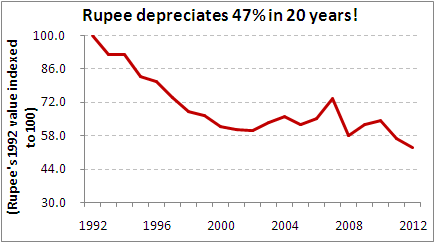
Since August 2011, one of the biggest concerns for the Indian economy has been the rapid decline in the value of the rupee. Moreover, there seems to be no end to this fall. With the rupee now touching an exchange rate of about Rs 54.8 per US dollar, the Indian currency continues to set newer records, albeit, on the lower side. In fact, this is not an anomaly but a long term trend. If you look at the rupee-dollar exchange rates over the past two decades, the rupee has continuously lost value against the dollar. In 1992, you could buy a dollar for just Rs 28.95. The same dollar would now cost you close to Rs 54.8. That means the rupee's value against the dollar has dropped by a strong 47% in the last 20 years.


Source: Rediff.com

Thursday, May 24, 2012


May 24, 2012, 5:59 am

India’s Faltering Economy Could Get Worse

People walk past a roadside currency exchange vendor in New Delhi, May 22, 2012.Adnan Abidi/ReutersPeople walk past a roadside currency exchange vendor in New Delhi, May 22, 2012.
Few economic experts in recent months have been as critical of India’s fiscal policy and governance and as bearish about the country’s economic future if reform does not happen as Rajeev Malik, senior economist with CLSA Asia-Pacific Markets, an independent research and brokerage firm.
Several recent indicators suggest his bearishness may not have been misplaced. In November of 2011 Mr. Malik warned that India’s currency could fall to 57 rupees to the United States dollar (at the time it was trading at about 52 rupees to the dollar) – on Thursday afternoon, the rupee was trading dangerously close, at 56.2 to the dollar. In December of 2011, he cut India’s economic growth forecast for the fiscal year that began April 1, 2012 to 6.3 percent, a forecast that has just recently been echoed by other economists.
Rajeev Malik, senior economist at CLSA Asia-Pacific Markets.Courtesy of CLSA Asia-Pacific MarketsRajeev Malik, senior economist at CLSA Asia-Pacific Markets.
In an interview with India Ink, Mr. Malik discussed Wednesday’s petrol price increase, what the government should do next and what role he thinks Congress Party President Sonia Gandhi plays in stifling economic reform in the country.
Q.
What are the options available to the central government and the Reserve Bank of India to slow the rupee’s free fall?
A.
The ball is very much in the government’s court and with Congress President Sonia Gandhi. The R.B.I. is doing whatever it can, and is taking a sensible approach. The last thing it should do is effect a particular level [for the currency] and then defend it at the cost of losing a large amount of foreign reserves. There could be greater pressure in the future on the currency from heightened global aversion, so it would be suicidal to squander reserves.
In all of this, the R.B.I. cannot be the savior. No central bank can be the savior. The Indian government creates the mess and the R.B.I. is the vacuum cleaner, but even a vacuum cleaner can’t do a good job in a garbage dump.
The first thing the government needs to do is wake up and acknowledge there is a problem. Just saying that there are external problems, when almost all of India’s problems are home grown, is not enough. The external issues amplify the domestic imbalances but government’s policies in recent years have significantly worsened those imbalances.
There are many Band-Aid fixes that can be done, but relevant long-lasting benefits require significant hikes in fuel prices to cut subsidies, getting the fiscal and current account deficits under control, improving the local investment climate, squeezing out inflation, attracting foreign direct investment and moving forward with reforms.
Growth is going to be trapped around the 6 percent mark and downside could still be there – it could clearly be lower if nothing is done by the government.
There are no painless options. The can has been kicked down the road so often and for so long, there will be unpopular moves but they have to be undertaken.
Q.
Is Wednesday’s steep petrol price hike a sign the government has finally woken up and is ready to make the reforms needed?
A.
It is a start but it only shows a government trying to marginally make up the distance it has fallen behind. It is still wedded to doing the least possible needed to avoid a major systematic problem rather than being pragmatic enough to undertake reforms so that India can do much better. It is merely doing enough for the economy to survive, not thrive.
Q.
What’s the next move the government should make after the fuel price hike?
A.
We have to see significant increases in diesel and cooking gas prices. The prices of other things, like electricity and coal, have to be closer to market-clearing levels.
The government needs to jump-start investment and create a more enabling environment for growth.
What makes the Indian situation so very unique is that it is not as if the problems are not known or the solutions; it is the implementation that doesn’t happen because of political myopia.
The current dual political structure doesn’t work. It is ironic that the world’s largest democracy has a selected, not popularly elected Prime Minister. The people who do understand economics don’t have the political strength to make decisions, those who have political power either don’t understand economics or are too fixated on populism.
Q.
What does a weak rupee actually mean? If it doesn’t have a big impact on most Indian citizens, why should politicians address it?
A.
A weak rupee is a symptom of the underlying problem, it is not the problem; it is the messenger rather than the message. It is the outcome of chronically high inflation, policy incoherence and self-inflicted injuries.
Consumer price inflation is over 10 percent, the rupee is in free fall, growth has been crippled and reforms have become a figment of people’s imagination.
The rupee has weakened more since the end of July 2011 than it did during the 1991 devaluation. The significant depreciation now will have a much smaller positive impact than in 1991 because it is not accompanied by a reform agenda. In 1991, the Indian government didn’t have a choice; the International Monetary Fund forced it to put in path breaking reforms.
A.
Q.
What is our worst case scenario? How low could the rupee go?
A.
We don’t know. No one can really forecast currencies very accurately, in the near term and given global uncertainty.
The rupee could easily fall between 57 and 60 to the dollar depending on how the European Union situation plays out. We just have to see what the government ends up doing.
Q.
You must speak with government and political advisers. Do you get the sense the central government appreciates the necessity of doing something now?
A.
There seems to be a disconnect. The people who understand the gravity of the situation and know what needs to be done don’t have the political capital to push through things. A lot of the relevant people get it; one doesn’t need to be a whiz kid in economics to appreciate what India is going through.
Q.
You mentioned Sonia Gandhi earlier – is she the major roadblock standing in the way of the economic reforms that need to happen?
A.
It is understandable that she has a political agenda. But strong and well-balanced economic growth will offer more, not less, opportunities for her well-intentioned redistributive agenda. Not undertaking reforms that will boost growth needed to meet the rising aspirations is a one-way path for the government to be out of a job.
I don’t think people are opposed to helping the poor. But the popularity of hand-outs needs to change. Growth is the best answer to poverty.
We require political will to do something. The more the government waits, the stronger and more unpopular these corrective measures will have to be.
This interview has been lightly condensed and edited. 
Farmers thrash paddy with cows in Panikhaiti village on the outskirts of Guwahati, Assam. According to local media reports the Brahmaputra River and its tributaries are rising at an alarming rate due to a heavy monsoon and destroying a large quantity of the rabi or secondary crop in the state.


European Pressphoto Agency
Farmers thrash paddy with cows in Panikhaiti village on the outskirts of Guwahati,
 Assam. According to local media reports the Brahmaputra River and its tributaries
are rising at an alarming rate due to a heavy monsoon and destroying a large
 quantity of the rabi or secondary crop in the state..
Today's Pics

Tibetan exiles protest against Chinese rule over
Tibet in New Delhi. (Express Photo: Prem Nath Pandey)

SCBs to come up in Sikkim, NE and areas populated up to 99,999


Souce: iSikkim

New Delhi, 23 May, 2012:
As per the extant Branch Authorization Policy of Reserve Bank of India (RBI), general permission has been granted to domestic Scheduled Commercial Banks (other than Regional Rural Banks) to open branches, in centres with a population up to 99,999 and in all centres of the North-Eastern States and Sikkim, subject to reporting.
In order to further expand the banking network, RBI has advised that while preparing their Annual Branch Expansion Plan, the banks should allocate at least 25 per cent of the branches proposed to be opened during a year in unbanked rural centres with population upto 9999. Further, under the “Swabhimaan” financial inclusion campaign, banking facilities have been provided to over 74,000 villages having population over 2000.
There are 93,659 branches of Scheduled Commercial Banks (SCBs) functioning in the country as on 31st March, 2012 out of which 34,671 branches are in rural areas and 24,133 are in semi-urban areas, which together constitute about 63 per cent of the total bank branches.
With a view of achieve the objective of greater financial inclusion, the Reserve Bank of India (RBI) issued instructions to all Scheduled Commercial Banks in November 2005, to make available a basic banking ‘no-frills’ account either with ‘nil’ or very low minimum balances as well as charges that would make such accounts accessible to vast sections of population. As per RBI, the number of no-frills accounts outstanding with Public Sector Banks (excluding Regional Rural Banks) and Private Sector Banks at end of March 2012, is 1032.06 lakhs.
This information was given by the Minister of State for Finance, Namo Narain Meena in written reply to a question in Rajya Sabha 
The Island of China


The island of China... That's no typo. The Gobi Desert, Tibetan Plateau, Himalayas, and Pacific Ocean surround the heartland of China like a geographic great wall. We're talking about a nation whose economic model has the world's best experts confused about whether China's about to take over the world... or collapse.

The best way to understand China is to start with its geography.

Wednesday, May 23, 2012


Source: Financial Express 

Samsung Electronics has announced the launch of Samsung GALAXY Tab 2 310, a 7-inch device that is available with 3G and Wi-Fi.
"Tablets are increasingly finding adoption amongst consumers because of their richer more converged experience. Users are able to surf the internet, enjoy multi-media and manage their work and life while being on the move,” said Mr Ranjit Yadav, Country Head, Mobile and IT, Samsung India.
The product weighs 345 grams and comes with a 4,000 mAh battery and 16 GB storage expandable to 32 GB.
It is priced at Rs 23,250. 


TAPI gas pipeline agreement signed
May 23,  7:26 PM
India and its new energy partners, Turkmenistan-Afghanistan-Pakistan on Wednesday signed agreements that will pave way for laying of the 1,680-km line gas pipeline TAPI.
The 1,680-km TAPI pipeline will have a capacity to carry 90 million cubic metres gas a day for a 30-year period and will be operational in 2018.

India and Pakistan would get 38 million cubic metres each, while the remaining 14 million cubic metres will be supplied to Afghanistan.

Describing signing of the Gas Sales and Purchase Agreement, GSPA as important event, Oil Minister S Jaipal Reddy said the TAPI gas pipeline will transform the politics of this region.