India, China to resume defence dialogue early next year
by Sandeep Dikshit
Plan to hold talks on border issue before year-end
India and China are seeking to put the recent exchanges over oil exploration in South China Sea behind them with below-the-radar contacts that could lead to an agreement on border incursions before the year end and resumption of the defence dialogue early next year. Diplomats are also working on ensuring that the 15th round of talks between Special Representatives on the border issue is held before the year ends.
These initiatives would add to the impetus provided by the first-ever Strategic Economic Dialogue, an idea proposed by Prime Minister Manmohan Singh, during which the two sides held in-depth discussions on water and energy besides other subjects. After a meeting with Chinese Premier Wen Jiabao, the two sides resolved to hold the second round within six months instead of the customary wait of a year during which Beijing would provide greater specificity on providing capital for India's infrastructure sector.
Asserting that there was no Chinese demarche on Oil & Natural Gas Corporation's (ONGC) plans to step up investment in South China Sea, government sources, however, were not unhappy with the manner in which the incident played out. But they discounted the impression that ONGC's oil exploration plan and the earlier ``non-event'' of a Chinese ship accosting an Indian Navy ship would affect the overall shape being given by both Governments to bilateral ties.
Explaining India's stand on the oil exploration issue, the sources said both blocks given to the ONGC for exploration lie partly in Vietnam's exclusive economic zone and partly in the sea claimed by China. “Our stand is that this is a purely commercial activity undertaken by a company. The dispute is for the two countries to sort out and India's participation in oil exploration does not amount to a political stand in favour of either country. Once the two countries sort out the issue India will talk to the country concerned,'' said the sources ahead of the visit by Vietnam President Truong Tan Sang.
The sources put faith in the early signing of the “Working Mechanism for Consultation and Coordination on India-China Border Affairs.” Both sides have agreed to move fast and two rounds of talks have been held since the idea was discussed by Dr. Singh and Chinese President Hu Jintao in April this year. Besides finalising the agreement, both sides are working on dates for a high level interaction at which the agreement could be signed.
“India wants to ask the world to look at the entire gamut of engagement with China and not one or two aspects,” said officials. It is in line with this that the Strategic Economic Dialogue was held for the first time with China with some issues discussed in depth for the first time. The 15th round of Boundary talks will be held before the year end in Delhi and both sides are also working on a fresh programme for defence exchanges that could be announced during the annual dialogue early next year.
India is also reaching out to emerging Chinese leadership. Last month, it invited Song Xiuyan, vice chairperson of the All Chinese Women Association and till February, the first woman Governor of Qinghai Province. The next high-level visitor will be Governor of Xinxiang who will come with a small business delegation.
source; The Hindu
Monday, October 10, 2011


India-China border mechanism by year-end
Despite the distraction posed by the South China Sea episode, India and China are well on course to putting in place a major confidence building measure on the border issue — a new mechanism to handle perception of incursions on certain pockets of the Line of Actual Control (LAC) — by year-end.
In recent exchanges, the two countries have broadened their contacts to cover energy and water at the first-ever economic dialogue and are expected to announce plans for greater military interaction early next year. The next round of boundary talks is also likely to be held soon.
source:The Hindu
Sunday, October 9, 2011
to build your people skills
5 ways to build your people skills
Source:Hindubusinessline

I am always pained by human resources people asking for “a seat at the table”. I have never seen any other function in the business making the same demand of their colleagues. Ever heard of a finance person asking for a seat at the table? Ever heard someone banging on the door demanding to be let in? Well, that's what it sounds like when someone says, “HR has earned a seat at the table”. How about designing the party where you want to be invited? As long as someone ... anyone else, can do your job half as well as you do, you stand the chance of not being invited to the party. You need to ensure that the key ingredient of the party is what you will bring in. If it is a dance party, bring in the music and be the DJ. You will have people pleading to have you over early so the fun can begin.
In addition to having a deep skill of all aspects of managing people and traditional areas of specialisation such as talent management and rewards management, HR professionals will have to supplement these with some new areas of expertise. Here are five new areas I recommend building your skills in. This is not just for HR people, but for anyone who wants to build their people skills for the workplace of the future.
Market research: The ability to mine data and generate insights will be a key skill. The insights should drive all the people decisions of the organisation. Think of the amount of effort that goes into understanding what the customer wants. Imagine the returns you would get if you put the same rigour in mining insights about your employees.
Technology: Comfort with technology will help professionals build their digital literacy. To be able to build a strong employer brand that is attractive to the current and potential employee pool globally, you will have to understand the possibilities that technology offers and see how you can leverage it. Millennials learn better through video. How about creating nifty videos of your ideas? And that does not mean getting a professional agency to do it!
Financial savvy & humane savvy: You will need to understand the financial implications of your choices. The implementation of the ideas will need to be done in a humane fashion. This is no longer a contradiction. It is the way in which business is expected to operate. While the decision has to be financially viable and good for the long-term health of the business, the leaders of the future workplace will keep the human element in mind.
Creative communication: The next decade will see a large number of people under 30 being added to the global workforce. Between 2010 and 2030, India will add 241 million people in the working-age population, Brazil 18 million, and China will add 10 million people in the same time. Think of this generation as one that speaks a foreign language that you do not know. That is the communication challenge of working in a multi-generational work environment. You have to learn to speak many languages. Some people find it hard to learn languages. The best time to start doing that is now.
Governance: You will need to build a deeper understanding of legal frameworks not just about laws relating to employment, but also about corporate governance, taxes, and sustainability that have so far been left to the legal department. Global leaders will need to learn at least the basics of the legal framework of doing business in a country and also know the basics of employment laws in operation. I am assuming you know these for the country you operate out of. How many others countries would fall in that category?
How well would you say you currently stack up against these areas? How would your colleagues rate you on these? Let me know.
(Abhijit Bhaduri is the Chief Learning Officer, Wipro)
Nasa satellite images reveal numerous landslides after the Nepal / Sikkim Himalaya M 6.9 earthquake
Last update: October 7, 2011 at 6:15 pm by By128 12share14 share155

October 7, 2011 By
Written by Dave Petley
Dave Petley is the Wilson Professor of Hazard and Risk in the Department of Geography at Durham University in the United Kingdom. His blog provides a commentary on landslide events occurring worldwide, including the landslides themselves, latest research, and conferences and meetings.
This article shows the first time NASA satellite images of the earthquake-affected area around Gangtok in Sikkim. Thanks again to Jesse Allan and all at the Earth Observatory at NASA for their help with this.
NASA have manage to collect a satellite image of the earthquake affected area around Sikkim in northern India, recently affected by the M-6.9 earthquake. This is quite a feat given that we are in the tail end of the monsoon season, when clouds are abundant in this area. The news reports and photos from the site have suggested multiple landslide occurrence in the earthquake, so of course an image is a good way to look at this. The image is a 10 m spatial resolution ALI image, which produces a product that looks like an aerial photograph, and thus is easy to interpret.
On the top of the image shown in the image below, there is a quite high incidence of landslides in the valleys. So lets take a look at one of these areas. First, one’s eye is certainly drawn to the landslides in the northwest corner.
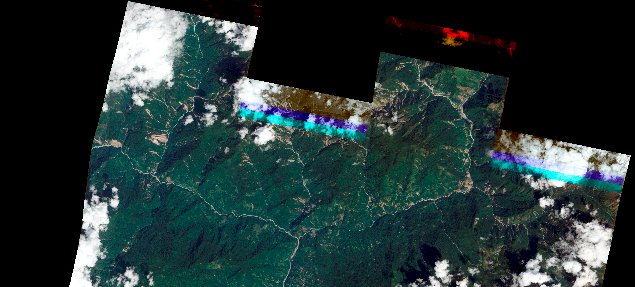 There are many landslides! A few things to note – first, most of the slides appear to the on the slopes that face towards the east and the south, there are few on the slopes that face to the west. The epicentre was about 45 km to the northwest of this location, so this directionality is of real interest, and personally I am slightly surprised by the fact that the slopes that failed were those orientated way from the epicentre, not towards it. Second, most of the slides appear to be shallow rockslides that have connected to the gully systems; many of them have initiated high on the hillside. There are also some large slides nearer to the main channels.
 Of course, a question that must always be asked is whether these landslides were triggered by the earthquake. There is a Google Earth image of this area from 2007, shown below. It is not great quality, but good enough to see that these landslides were not present at that time. It is likely, given the directionality of the landslides, and the fact that they are clearly very fresh, that the majority were triggered by the earthquake. However, it is also possible that some were triggered by a monsoon rainfall event ahead of the earthquake.
 I will try to post again on the area of the image to the east of the above, which also has many landslides. It will be fascinating to take a look at the area off this image to the northwest – i.e. around the epicentre in the really high mountains. This is where any really large landslides are likely to be located.
Dave Petley is the Wilson Professor of Hazard and Risk in the Department of Geography at Durham University in the United Kingdom. His blog provides a commentary on landslide events occurring worldwide, including the landslides themselves, latest research, and conferences and meetings.
This article shows the first time NASA satellite images of the earthquake-affected area around Gangtok in Sikkim. Thanks again to Jesse Allan and all at the Earth Observatory at NASA for their help with this.
NASA have manage to collect a satellite image of the earthquake affected area around Sikkim in northern India, recently affected by the M-6.9 earthquake. This is quite a feat given that we are in the tail end of the monsoon season, when clouds are abundant in this area. The news reports and photos from the site have suggested multiple landslide occurrence in the earthquake, so of course an image is a good way to look at this. The image is a 10 m spatial resolution ALI image, which produces a product that looks like an aerial photograph, and thus is easy to interpret.
On the top of the image shown in the image below, there is a quite high incidence of landslides in the valleys. So lets take a look at one of these areas. First, one’s eye is certainly drawn to the landslides in the northwest corner.
One’s eye is certainly drawn to the landslides in the northwest corner
Most of the slides appear to the on the slopes that face towards the east and the south
Google Earth image of this area from 2007
We encourage our readers to read regularly Dave Petley “The Landslide Blog”, probably the best in the world!
Source: Dave Petley and “The Landslide Blog“
Source: Dave Petley and “The Landslide Blog“
India-A Positive Outlook
India-A Positive Outlook
By Sanjay Kumar Singh | Oct 4, 2011
In most interviews that we do, we get an insight into what is happening in the markets. Rare is the interview where we come across simple, distilled, timeless wisdom. This is one of them. Here, Ajit Dayal, chairman, Quantum Mutual Fund, dwells on a wide range of market and economy-related subjects. Two points emerge very strongly. One, he says, if you shut out the day-to-day noise regarding what is happening in the markets and instead focus on a stock’s long-term fundamentals, it lends clarity to your investment approach. The second point that Dayal makes is that those in business must be guided by a strong moral compass. He advocates not paying bribes, fighting corruption, and highlighting the racketeering that is going on within one’s industry — even if its means paying a price. His views come like a gust of fresh air in this scam-tainted world that we live in. Read and savour them. This interview was conducted by Sanjay Kumar Singh and Anindya Bera.
There is a debate going on regarding whether the Indian economy is headed for a hard landing or a soft patch. What are your views on this subject?
The Indian economy will grow at between 6.5 per cent and 7 per cent per annum, on average, for the next decade. Between 1980 and 2010, the Indian economy has grown at an average rate of growth of 6.3 per cent per annum. Since we focus on the long run, we are not part of this hard-landing or soft-landing debate. I think India’s GDP growth will be pretty solid with maybe 5.5 per cent in a bad year and 8 per cent in a good year.
Do you see the slowdown in government and corporate capex as a big problem? Or do you see a recovery in the near future?
Well, I think this capex slowdown is led by the inability of corporate India to identify who to bribe to get their work done! We all know the scrutiny that has started ranging from Adarsh, to CWG, to 2G. So, the taker of the bribe is scared as is the giver of the bribe. Most Indian businessmen — small, medium, or large scale — complain that they cannot get anything done unless they bribe. That is their defence. Have they ever thought of not giving a bribe and living with the consequences? Of trying to fight the existing system? But they point out that the reality is if they don’t bribe, then someone else will — which may be true. It still does not make it right. The argument is the same as those offered by people who work for large financial firms profiled so brilliantly in the film, “The Inside Job”. Making this film available to investors is the best thing that SEBI and RBI could do to educate investors. The herd of MBAs claim that if they do not take the jobs offered by financial firms that have been built to fleece their clients, then someone else will. We live in a world of immorality. And we go about getting rich and aiming to be in some ranking list of the wealthy in India. Or some ranking list of the largest mutual funds in India. I don’t have a prescription for how to get mega rich without bribing. But I do have a suggestion for those who don’t want to bribe or be part of an opaque system — just stop paying the bribe and try to change the system by highlighting the racketeering in your industry. We have done that in the mutual fund industry — we are still small, but we are happy doing the right thing.
Does consumption still remain robust or is it beginning to slow down also?
Salaries in India are growing at over 15 per cent so the income earning power and power to consume is still there. But it is true that higher prices eat away the incomes of the lower middle class. So, the upper middle class, who spend much of their money on non-food items, will still consume. The lower middle class, who spend a larger proportion of their income on food and other basics, could consume less. They may shift down the quality curve for certain items like, say, shampoos.
Do you see any movement on the policy front which could possibly improve sentiments within the markets?
I think a quick punishment of those who are corrupt and under trial will send a great message. The 2G spectrum, the coal mines, and the hydrocarbon assets belong to the country. If there has been any swindle in the sale of these assets, then confiscation, fines, and jail terms need to be handed out. I think that will send a great message to the people. It may set off a chain of protest letters from the captains of industry, but we should recognise that many have a vested interest in the existing system. Not a single so-called business leader had the guts to write a letter to the Prime Minister when Mr. Bhave of SEBI was not granted an extension of his chairmanship. Here was a man trying to change the ethical framework of the financial services industry and where were the so-called captains? Well, they were ensuring that their rich ships were not at risk of hitting an integrity iceberg. They are so used to navigating in murky waters that any chance of a clean-up is a threat to them. Again, there are a few decent people running businesses — please don’t get me wrong. But they are a silent minority. And their silence is troubling.
How do you see foreign institutional investors (FIIs) behaving in the second half of the year? What will it take to bring about greater FII inflows into India?
The intrinsic value of an Indian company is the function of the earnings power of a company that will be driven largely by what happens in the domestic economy. But the share price of that Indian company will be a function of whether FIIs are buyers or sellers. So, the scenario I have in the global environment is that there will be a financial disaster. FIIs will sell, Indian stocks will crack, and then there will be a few months of watching the Indian economic and corporate data. The data will be good. FIIs will head back to India and share prices will rebound sharply — a pattern similar to what happened between October 2008 and March 2009. What I don’t know is when this financial disaster will occur. It could be today, next week, next month, or next year. Investors have to position themselves for massive uncertainty, not by selling shares but by ensuring that they have a good mix of shares, fixed deposits with nationalised banks, liquid cash, and gold. The proportion of these assets is a very individual choice, but personally I prefer something like keeping 18 months of basic living expenses in a mix of liquid cash and fixed deposits of nationalised banks, and the balance in some 80/20 or 90/10 mix between shares and gold. And if you are older and retired maybe you may want to keep more in fixed deposits and less in shares. But this mix needs to be thought out carefully based on your individual needs.
You have been critical of the quantitative easing programme that the US adopted to get over the crisis. What would your prescription have been?
The US government rescued Fannie Mae, the largest owner of home loans in USA, but made sure that its shareholders got wiped out. It nationalised the company. But the treatment of Citibank, Goldman, Morgan, and Merrill was different. There was a sponsored rescue either by the government or by a stronger institution, but the shareholders were not wiped out down to zero. These were all failed institutions just as Fannie Mae — the mortgage underwriter — was. Yet, the government used taxpayer money to rescue them and did not own 100 per cent of them. The rationale was that if the government took them over, the talented geniuses would leave these companies and only they knew what they had done! What a racket! These geniuses blow up their firms, the wealth of their clients, the global financial system — and then they claim that their superior IQ is needed to rescue the world and we cannot live without them. History will record this event as the boldest, brashest, and most successful daylight robbery ever conceived in the history of mankind. Please do see the film “The Inside Job”. In July 2009, I was giving a talk at a conference in Vancouver, Canada. And I was asked the question: how can I recommend investing in a country like India, which has huge corruption? I responded that corruption was a huge problem and that India was trying to resolve it with efforts like the Right to Information (RTI) Act and by using more technology for transactions. I then proceeded to ask the gentleman, an American, how he could ever invest in a country where Wall Street seemed to run the government as these bailouts suggested. There were 1,000 mostly Americans in the room — and many clapped. The prescription for a more humble world of finance is the forced break-up of large companies, a global freeze on salaries for everyone in the field of finance, and the ability to shut down the crooks and never let them enter this field again. But the chances of this happening are close to zero. So, investors need to be prepared for more crises and they need to protect their wallets — the financial geniuses are eyeing it all the time.
How damaging has quantitative easing been for the global economy, and for India in particular?
There has been no impact on India, as such, barring some rise in commodity prices probably due to a survival of risk-taking hedge funds. For the global economy, there has been an illusion of a return to wealth. This is largely driven by the US consumer still consuming and China still willing to hold on to US debt. The US has got more real goods in the past three years and China has received more IOUs from the US government in exchange. The fact is that the US needs to consume less and save more. And China has US dollar debt that is at risk of being equivalent to the value of toilet paper. So, India will also be affected because we own US government debt — but we own less of it. And the RBI has been buying gold. The RBI should buy more gold.
Coming to the Euro zone, Greece is not the only country facing default. The list is getting longer each day. Is there any solution to the Euro zone sovereign debt problem in sight or will it plague the region for a long time to come? Will France and Germany succeed in keeping the Euro zone together for long? The Euro currency may survive but not in its present form. Some of the euro countries may have to resort to their own currencies. Greece could head back to the drachma; Spain to pesetas; Italy to lira. Currency unions are plausible when all the economies within that union follow the same fiscal and monetary policies, when they all march to the beat of the same drum. Bonds issued by all these countries were for years trading as if they were all the same risk — note this as another example of a high-volume market with a totally wrong price! The European banks have large exposure to these troubled countries. They will need to be rescued as there will be a rescheduling of debt and a haircut for the holders of Greek debt. This write down of NPA (non-performing assets) will require banks to have more capital. Hence, the need for these banks to be rescued.
Which are the sectors that you are bullish on at this point of time?
Well, the team at Quantum Long Term Equity Fund are bottom-up stock pickers. I have given you all these macro views but that is not how they pick the stocks we invest in. We are not top-down investors; we focus more on the management and its ability to withstand tough environments, including a Lehman-like bust. We ask ourselves the basic question: will HDFC survive a globally tough environment or ICICI Bank, or both? Will Lever survive tough times or Godrej, or both? And what is the valuation of the stock at this point in time?
source:Valueresearch


You can be jailed for default in fund transfer via ECS
G. Naga Sridhar
Hyderabad, Oct. 8: If you pay your loans through the electronic clearing service, you better ensure there is sufficient fund in your account.
Else, you can land up in jail, according to a latest circular from the Reserve Bank of India.
Increasingly, people are opting to repay loans or other financial commitments electronically by giving a mandate to banks for monthly deduction from their accounts on a specified date instead of giving post-dated cheques. But many of these commitments are apparently not being honoured as there is no clarity on the punishment.
However, in a circular sent to banks a couple of weeks ago, the apex bank communicated that the same set of rules against dishonour of cheques, according to Section 138 of the Negotiable Instruments Act, 1881, would apply for dishonour of electronic fund transfer instruction.
“Section 25 of the Payment and Settlement Systems Act, 2007 accords the same rights and remedies to the payee (beneficiary) against the dishonour of electronic funds transfer instruction as are available to the payee under the Negotiable Instruments Act,'' the RBI said.
IMPLICATIONS
The implications of this circular for individuals and banks are significant.
“This is a welcome clarification as it brings parity between cheque-based payments and electronic fund transfers,'' Mr Nagesh Pydah, Chairman and Managing Director, Oriental Bank of Commence, told Business Line.
According to a senior official of Andhra Bank, many loan repayments through ECS mandate submitted to a bank are regularly dishonoured while maximum care is taken to honour post-dated cheques.
Most of these commitments are not being honoured as there is no clarity on punishments prescribed legally till now while remedies are available for dishonour of cheques.
“As a result, banks are also collecting a few post-dated cheques even for electronic funds transfer commitments,'' said an HDFC Bank functionary.
More teeth to banks
“The RBI's circular will give banks more teeth to ensure that the repayments through electronic mode would be more regular,'' he added.

Saturday, October 8, 2011


GST and its benefits
Call it a double edged sword. The much awaited Goods and Services Tax (GST) that is expected to be introduced next fiscal year can become the much needed weapon in the government's armor. Saddled with the twin problems of high inflation and high fiscal deficit, the government can use the GST regime to improve India's economic statistics. As per industry body ASSOCHAM, GST will enhance India's tax to GDP ratio by nearly 1.6%. The same will have a benign impact on the economy's fiscal deficit. Moreover, GST will remove cascading taxes, leading to reduction in prices of most manufactured goods by about 10%. This will certainly come as a relief to the policymakers as well as the central bank both of which have been trying their best to rein inflation. Higher savings, improved tax compliance, economies of scale, and supply chain efficiencies are expected to be the icings on the cake. While the much awaited fiscal reform sounds very promising, we really hope that the impleme ntation is satisfactory enough to deliver the desired results.
By J Mulraj
By J Mulraj


Friday, October 7, 2011

FINISHING STRONG
by Dan Green
On August 1, 1914 Sir Ernest Shackleton set sail with a crew of 28 on an expedition to the Antarctic. The mission of their expedition was to cross the Antarctic on foot - something never done before. Shackleton was a successful and highly respected explorer known for his faith, determination, creativity and conviction. He was knighted for his successful expedition to Antarctica in 1907-09.
In order to recruit his crew of 28 he took applications from 5,000 men. Many believe that he placed the following ad in a London newspaper to attract the applicants. While there is no evidence that this ad actually ran, it does quite appropriately frame the environment that Shackleton was trying to recruit for.
Men Wanted: For hazardous journey. Small wages, bitter cold, long months of complete darkness, constant danger, safe return doubtful. Honour and recognition in case of success.
This expedition was going to be different than any other one that Shackleton had led. Five months into the expedition their ship, the Endurance, became stuck in the heavy ice flows near Antarctica. It was not uncommon for ships to get stuck periodically in the ice flows and Shackleton believed that the ice would eventually recede and free the ship. His focus was on the expedition and he held fast on that course. However, over the next three weeks the ship became solidly frozen in the ice. Attempts to free the ship were futile. At the end of February, 1915, the crew prepared the ship to become their camp for the remainder of winter. At this point, Shackleton abandoned his primary goal for the expedition and turned his focus towards returning to England.
His expedition had become a rescue mission.
By October, eight months after being stuck, the pressure created by the ice finally took its toll on the Endurance. The ship began to come apart and sink; making it uninhabitable. The order to abandon ship was given and the entire crew began to salvage as many supplies as they could. They took the sled dogs, food, gear and three lifeboats and moved their camp to the ice flow next to their sinking ship.
The temperatures were brutal; reaching -15°F on average. For the next five months the expedition camped on the ice flow surviving on what little food they had left. In April the ice flow they were camped on began to break apart. Shackleton ordered the crew to take only essential supplies and board the life boats. They fled the disintegrating ice flow and traveled seven days by sea to Elephant Island. Elephant Island was a barren place to be stranded; made up mostly of rock covered snow with temperatures reaching -20°F.
For the next nine months, under Shackleton's leadership, the broken expedition remained loyal, optimistic, focused and faithful to their leader's belief that they would survive. Ultimately, Shackleton knew that their survival depended upon his ability to reach a whaling outpost that was more than 800 miles across the most treacherous ocean seas in the world.
Determined to save his crew, Shackleton set-out in one of the lifeboats with five crewmembers to make the journey. The odds of making it were 1 in 100. Nautical scholars consider this journey by lifeboat to be one of the greatest nautical accomplishments in maritime history. Shackleton successfully made it to the outpost and returned to Elephant Island with a rescue party four months later.
On August 30, 1916 after 22 months of being stranded on a barren rock in sub zero temperatures, the crew of the Endurance was rescued. All twenty eight crew members survived the ordeal and most were quick to credit the strong faith of their leader as the catalyst in their survival.
Justice Permod Kohli elevated to Sikkim HC
06.10.2011 | 17:12
Chandigarh
by Lalit Kumar
Justice Permod Kohli of the Punjab and Haryana High Court has been elevated as the Chief Justice of the Sikkim High Court. The orders were officially conveyed to the High Court on Wednesday.
At the same time, the Supreme Court has also issued the transfer orders of other two judges being Justice Mahindra Pal Singh and Justice Ajay Lamba. Justice Mahindra Pal Singh has been transferred to Gujarat High Court and Justice Lamba is slated to be transferred to either to the Allahabad or Orissa High Court.
Justice Kohli joined the Bar at Jammu after enrollment on 12 October 1972. He was appointed Additional Advocate General of the state during Governor's rule in the year 1990 and took over as the Advocate General in December 1990. He continued as Advocate General till January 1992 and was designated a senior advocate in April 1991. He was later appointed Additional Judge of the High Court of Jammu & Kashmir on 07 January 2003 and as permanent Judge on 03 January 2005. He was later transferred to Jharkhand High Court, Ranchi and took oath on 04 May 2006. Thereafter, he was later transferred to Punjab and Haryana High Court and took oath on 10 May 2007.

Thursday, October 6, 2011
Subscribe to:
Posts (Atom)