Total Pageviews

Thursday, February 14, 2013


From hotel chains to flower shows, Sikkim is going global

Mainak Sain, TNN Feb 12, 2013, 03.30AM IST
GANGTOK: Sikkim gets its name from a combination of two Limbu words: su, which means 'new', and khyim, which means 'palace' or 'house'. With its hospitality, power, health andpharma sectors booming, Sikkim is not only inviting investors, it is all set to play the development partner.
Chief minister Pawan Chamling, outlining the broad parameters of Sikkim's new development model, said land will not be a constraint for willing investors and promised full cooperation for infra needs.

Supreme Court Stay on Old Settlers' Petition on Income tax

SC stay on Sikkim tax dues
-Old settler petition says 1961 Act discriminatory

New Delhi, Feb. 12: The Supreme Court yesterday stayed the recovery of income tax dues from “old settlers of Indian origin” in Sikkim and sought the Union government’s response to a petition that challenged the collection of the central tax from them.
Last year, around 400 families in Sikkim refused to file income tax returns and demanded exemption that applies to those who have Sikkim Subject Certificates.
The Chogyals had issued the Sikkim Subject Certificates (SSC) to people living in the state during 1961 under the Sikkim Subject Regulation Act of 1961. The 400 families, also known as “old settlers”, came to the state before 1975, when Sikkim merged with India, but they do not possess the certificates. The Centre had exempted SSC holders, about 95 per cent of Sikkim’s population, from paying income tax in 2008 after an amendment in the Finance Act by the Parliament based on the state’s request. That year, Association of Old Settlers Of Sikkim filed a petition with a Rajya Sabha Committee saying it was discriminatory and violated Article 14 (equality before law) and 15 (prohibition against discrimination) of the Constitution.
Yesterday, senior counsel K.K. Venugopal and counsel Senthil Jagadeesan who appeared for the Association of Old Settlers Of Sikkim submitted that Clause 26 AAA of Section 10 of the Income Tax Act, 1961, was discriminatory and violated Articles 14 and 15 as 95 per cent of the state’s population that was exempted from paying tax “includes about 70 per cent people of Nepalese origin, and the entire exemption has come about to appease the electorate.” The remaining 5 per cent was to pay the taxes.
It was submitted that the demographic profile of Sikkim, according to the 2004 voters’ list, shows that Bhutia-Lepcha (STs) are about 20.64 per cent of the population, Nepalese constitute 69.71 per cent, Sherpas are 4.31 per cent and others make up 5.34 per cent (old settlers: 1.5 per cent and migrants: 3.84 per cent).
The petition said, discussions between Sikkim and the Union of India disclosed that SSC holders and those who became citizens in 1990-91 after the Sikkim Citizenship Amendment Order 1989 should be exempted for political reasons and to maintain ethnic peace in the state and SSC holders who had voted for the merger of Sikkim with India be rewarded by granting exemption.
“This is the reason for the differential classification whereby 95 per cent of the population in Sikkim is exempted from the Income Tax Act, 1961, while 5 per cent of the population including the old settlers of Indian origin are liable to be taxed,” a member of the association said.

Tuesday, February 12, 2013


Branded tea market to double in five years

Rapid change in consumer behaviour may support the market more than its unbranded segment


Rapid change in consumer behaviour is likely to support the branded tea market more than its unbranded segment. Consequently, the branded tea market is expected to double in the next five years.

With 20 per cent compounded annual growth rate (CAGR), the branded tea market constitutes nearly 55 per cent of the market size with around 980 million kg of India’s overall output. A recent study by the Associated Chambers of Commerce and Industry of India (Assocham) forecast India’s tea market to touch Rs 33,000 crore by 2015 from Rs 19,500 (in 2011).

“The total branded tea segment in India, currently valued at Rs 6,000 crore, is expected to double in the next five years. The domestic coffee consumption, too, has been continuously growing at an annual average rate of six per cent and is largely on account of a thriving independent upscale cafĂ© culture,” said Priti Kapadia, director of Sentinel Exhibitions Asia.

Sentinel Exhibitions is the organiser of the World Tea and Coffee Expo (WTCE), scheduled on February 15-17 in Mumbai. Domestic coffee outlets, which have a lot of appeal for the new generation, are set to double within three years, fuelled by the foray of global players such as Starbucks and Dunkin’ Donuts in India. WTCE is India’s only trade show dedicated to the hot beverages sector.

Companies in the last decade have positioned tea and coffee as recreational products, which proved beneficial in attracting the younger population. Furthermore, the focus on high-protein, low-sugar diets is stimulating demand for green tea, ground coffee and artificial sweeteners, which have shown strong signs of promise over the past three years, Priti added.

The Assocham study further said that with nearly 600,000 hectares under tea cultivation, the domestic tea industry is growing at a CAGR of about 15 per cent.

India is the world’s largest consumer, second largest producer and fourth largest exporter of tea after China and accounts for nearly 30 per cent of global output. Nearly 25 per cent of tea produced worldwide is consumed in India, said the study.

Monday, February 11, 2013

500 New Community Radio Stations by the End of XII Plan
Rs.100 Crores to Promote CRS Movement in XII Plan- Manish Tewari
I&B Minister Confers Awards for Excellence at the 3rd Community Radio Sammelan
The Government in order to give the Community Radio movement a fresh impetus would be providing Rs.100 crores in the XII Plan. During the Plan period, it was proposed to set up 500 new Community Radio Stations (CRS) also. This was stated by Shri Manish Tewari, Minister for Information & Broadcasting, while delivering the valedictory address at the 3rd National Community Radio Sammelan here today.

Shri Tewari further stated that the Ministry had identified key benchmarks for the Plan period whereby a roadmap would be prepared to provide assistance for operating Community Radio Stations. Elaborating on the proposal of the Plan fund, the minister said Rs.90 crores had been proposed for providing financial support, while Rs.10 crore was being proposed for training, capacity building and awareness activities of Community Radio Stations. Provisions had also been made for providing grants in this sector, for research and innovations. Taking into account the role and relevance of such interventions, the Minister further added that the Ministry has also made a provision for Emergency Grant for CRS. The Minister further mentioned that in order to encourage the working of such stations, several key proposals and initiatives were being looked into that included Peer Review of Community Radio Stations, capacity building of community Radio operators, Code of Ethics for self-regulation of content by Community Radio Stations.  

The Minister also elaborated on the efforts being made by the ministry in coordinating relevant issues with the Ministry of Communications & IT with regard to better frequency allocation plan for the CRSs. He mentioned that it was likely that the Department of Telecom would announce the spectrum waiver decision shortly. The need to facilitate a vibrant business model was in the offing to ensure the sustainability of the movement. Shri Tewari said, the ministry had taken the initiative to promote the streamlining and simplification of Community Radio empanelment through DAVP thereby ensuring that the empanelled stations got a fair share of Government advertisement.

The Minister also conferred various awards on the occasion. The awards were given for various categories to CRSs operating in different parts of the country. Lauding the efforts of the participants, Shri Tewari said the innovative work done by such institutions ensured community empowerment through communication dissemination. At the same time, it was a great effort at capacity building at the rural level promoting communication, content and dissemination in a form and language understood by the people. These Stations reflected the relevance of communicating to the community through a process identified and implemented within the community. The Minister gave the awards :Details are as under-
 Most Creative /Innovative Programme Content Awards:
First Prize
Radio Mewat, Run by SMART NGO, Nuh, Haryana, for its programme, “Apki Police ApkeDawar”
Second Prize   
Radio Benziger run by Benziger Hospital Society, Kollam, Kerala, for its programme, “Jana Shabdam”

Third Prize
SSM Community Radio, SSM College of Engineering, Namakkal, Tamil Nadu, for its programme, “ThaimaieaThayangathey”

Thematic Awards:
First Prize
PuduvaiVaani, run by Pondicherry University, Pondichery, for its programme, “UngalaiThedi”
Second Prize   
Radio Benziger run by Benziger Hospital Society, Kollam, Kerala, for its programme, “EnikkumParayanundoru Katha”
Third Prize
Rudi no Radio, run by Sewa Academy,Ahmedabad,                                           for its programme, “KaagajKamdar”

Community Engagement Awards:

First Prize
Radio Media Village, run by St.Joseph College of     Communication,Kottayam, Kerala, for its programme, “Thanal”.

Second Prize   
Rudi no Radio, run by Sewa Academy, Ahmedabad, for the programme, “Right to Information”
Third Prize
 CMS Radio, Run by City Montesri School, Gomti Nagar Lucknow, for its programme, “RaushanHuaJahan”
Promoting Local Culture Awards
First Prize
KisanvaniSironj, run by Indias Society of Agribusiness Professionals,Sironj, M.P., for its programe, “HamareKalakar”

Second Prize   
Neladani CR, run by DivyaJyothiVidyaKendrs, Bangalore, for itsprograme, “Janapadaloka”

Third Prize
CMS Radio, Run by City Montesri School, Gomti Nagar, Lucknow, for its programe, “Community KaKamaal: Ekta-Ramleela”

Sustainability Model Award:

First Prize
Radio Mattoli, Wayanad Social Service Society, Wayanad, Kerala


CP/ST

FLOWER POWER: Sikkim set to host International Flower Show


IANS
February 04, 2013

Circle of flowers:  This is the Circular Garden or the Sunken Garden because of its bowl-shape and terraced garden.
Flowers and nature lovers will script a new tourism trail in Sikkim when the state plays host to more than 200,000 visitors at the second International Flower Show in Sikkim Feb 23-27 that will combine business, fun and a renewed commitment to protect the fragile environment of the Himalayan
state.
Home to nearly 5,000 species of flowering plants, 515 rare orchids, 60 primula species, 36 rhododendron species, 11 oak varieties, 23 bamboo varieties, 16 conifer species, 362 types of ferns and ferns allies, eight tree ferns and over 424 medicinal plants, Sikkim is pinning its business aspiration on floriculture and related trade as one of the primary economic lifelines of the future.
The international flower show will draw participants from the Netherlands, Australia, New Zealand, China, Taiwan, Thailand and Nepal as well, the Political and Economic Journal of Sikkim said in a report in its latest issue.
On display will be an array of exotic flowers like cymbidium orchids, rhododendrons and liliums.
The contingent of 550 participants at the show will include 75 growers, officials of horticulture and agriculture and others officials.
"With Sikkim's five climatic zones, we have been home to some of the most beautiful flower varieties. I see floriculture as a profession of the 21st century," Chief Minister Pawan Chamling told the Journal.
Sikkim Governor B.P. Singh recalled how he was taken aback with the beauty of flowers in northern Sikkim.
"The colours and beauty are difficult to put into words," he said.
The government is serious about promoting floriculture, enhancing not just the beauty of the state but also the lives of farmers who have taken to floriculture for a living. It has set up training schools at the district elevl to train flower growers.
Prahma Pradhan, a floricultarist, sells 50-100 roses daily. When she began growing flowers to supplement her family's earning, "it wasn't without scepticism". Today her family is earning well.
"The idea is to showcase to India and rest of the world the variety of flowers we grow in Sikkim. Also for the farmers, it is a wonderful way of connecting with more buyers... We are learning every day. We have cold storage vans at the farms, which help farmers deliver flowers safely. Once they reach a central location, there is a bigger storage facility from which flowers are sent to other parts of India and countries," Horticulture Minister D.N. Thakarpa told the Journal.
Apart from the flowers, there will also be an exhibition of vegetables, spices, roots and tubers, bamboos and mushrooms, tools equipment and organic inputs.
Sikkim is situated in an ecological hotspot of the lower Himalayas, one of the only three among the eco-regions of India. The orchid dendrobium nobile is the official flower of Sikkim, while the rhododendron is the state tree.

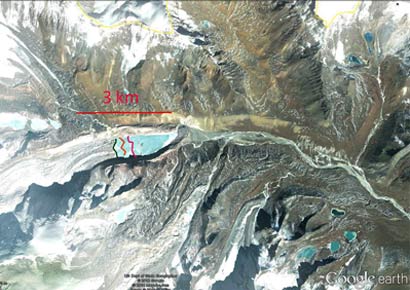
Huge glacial lake atop Himalayas poses danger in Sikkim


Published: Sunday, Feb 10, 2013, 15:55 IST
Place: Bangalore | Agency: IANS
The South Lhonak Glacier, which drains east from Lhonak Peak into Sikkim from the Nepal-Sikkim border, has developed a lake whose outburst probability is very high at 42% and peak discharge estimated at 586 m3/s.
A satellite-based study has indicated that a huge glacial lake has formed atop the Himalayas in Sikkim with a "very high" potential for it to burst and create devastation downstream.
Analysis of satellite data has revealed that the lake has formed at the snout of South Lhonak glacier, that is about 7,000 meters high on the mountain in the northeastern state. The lake, bounded only by loose soil and debris, could cause havoc downstream if it ruptures, according to scientists at the National Remote Sensing Centre (NRSC) in Hyderabad.
In a report published in the latest issue of the journal Current Science, NRSC researchers Babu Govindha Raj and co-workers say the glacial lake is about 630 meters wide and 20 meters deep.
It covers an area of 98.7 hectares and contains 19.7 billion liters of water. A sudden outburst "can create devastating floods downstream," they warn, adding that the probability of this happening "is very high". They, however, note this is only their preliminary assessment and more field studies are required to confirm the hazardous potential of this high altitude lake.
Data from the American Landsat, CORONA and Terra satellites besides imageries from India's own Resourcesat-1 satellite were used to estimate the size of the shrinking Lhonak glacier and the growth of the glacial lake at different times between 1962 and 2008.
Based on this study the scientists estimate that the Lhonak glacier had receded 1.9 km between 1962 and 2008. The glacial lake that was initially a small body of water in 1962 grew in size with accumulation of melt water. The NRSC scientists say that the lake is still attached to the snout of the glacier but is expanding in area due to the glacier retreat.
"The rate of growth of the lake indicates possible developments of the hazard situation," the report says.
As Himalayan glaciers are retreating fast, it is necessary to make an inventory of glacial lakes and set up an early warning system for lake outburst floods in vulnerable areas, they say.

Saturday, February 9, 2013


Transforming Indians to Transform India Poem written by a Teacher in Chinmaya International Residential School.

Transforming Indians to Transform India
In the interest of the nation… 14/08/12
Diwakar K.S. HOD /Dept of Social Science/s – CIRS
Trained minds can take India onward ;
Realizing noble ideals is a step forward.
Ageless culture is our possession.
No way, should we let it go in recession.
Science and Technology have grown in abundance;
From day one of our independence.
Ordeals and disharmony – manifests now and then;
Ruthless we should be in curbing it as and when.
Master-minded patriots prophesized a message;
India will illuminate – in the present age.
Nalanda revival – a timely venture.
Glory of Auroville is a seismic wave of conjuncture.

India is an ideal peace-lover’s domain.
Name it Project India, Vision India or Shining India.
Dawn of democracy and tranquility will emanate from Asia.
In the midst of troubles and turmoil;
All  that is needed is sheer power of will
Nation-building is the ship we sail.
Success is what we need to avail
Time has come for us to lead;
On top of the world, is the Indian Breed
Tainted leaders- show them the exit ;
Rejuvenated youth should often meet
All- round   development – we seek
Nation’s pride is what we reap.
Super human efforts lay in wait ;
Find a role which can take you to great height ;
On top of the Himalayas – chant India’s glory;
Reverberating success is a never ending story.
Mesmerize the world with relentless energy and no weariness.
Invite ideas, invoke blessing, ignite passion;
New dawn needs to be unveiled.
Deficient areas be sealed and not concealed.
Innovation should transcend in day week and month;
All stumbling blocks of our nation will turn into strength.

A royal funeral in Cambodia: Pics (© AFP)

A Royal Funeral in Combodia

A royal funeral in Cambodia: Pics (© AFP)


We dream of a Prosperous and a Just India.
We seek a united and truly educated India.
We need a corruption-free and efficient India.
Everyone thinks about what they need from India.
Have we ever thought what India needs from us?
If I need a new India, India needs a new me.
India is what we the people make it.

5 decades of independence, more than 10000 years of recorded history, more than 1 billion people, 686 districts, and one Nation – a Nation still awaiting a transformation – not in the laws and the roads merely, but in the very core of its existence, its very soul, its people.  

Transforming Indians to Transform India is an attempt by Chinmaya Mission to transform that core of the country with the vision… My Transformation Transforms Nation

We proudly present a 3-year National movement Transforming Indians to Transform India - a nationwide movement carried through in a quiz, written about in a book and lived by an entire country…

The movement has been launched on 15th August 2012, the nation has begun the Transformation. Many Indians are joining it. Join us in the Transformation. To know more about the movement, click here. 

Sign up now for the Transforming Indians to Transform India Quiz.

Visit- Chinmaya Mission, Sikkim Centre at Development Area, Gangtok or Just Call
94340-23594


Our Vision

The vision is Transformation of a vast, vivid and vivacious nation. INDIA. Yes, India is in for a transformation. But how?

We are not doing something like building new airways or amending old laws! In fact we are doing something so potentially powerful that it almost bears in itself the inspired enthusiasm of a spark of fire. It has the power to ignite millions of minds, kindle magnanimous transformations, and set a ablaze a fire that can sweep through the nation and make it a new, a different, a Transformed India. We are only  transforming Indians.

A nation’s true transformation depends entirely on its people.  Hence our call to the nation is most direct:


“If Indians transform to become physically fit, emotionally strong, intellectually refined, culturally rooted, actively patriotic and spiritually uplifted with the vision of universal oneness, India will be revitalized.  Indians will not only gain at a personal level, but will be positive contributors to the society and the world at large” says Swami Mitrananda, the conceiver of the movement and a Director of All India Chinmaya Yuva Kendra, the Youth wing of Chinmaya Mission.


Why Transform Nation?

A nation with a magnificent past, India is notable on the world map today as the largest and most vibrant democracy, and a nation experiencing rapid economic development. India is sought-after for her cultural and spiritual depth, geographic and cultural diversity from snow-dusted mountains to sun-washed beaches, tranquil temples to feisty festivals, lantern-lit villages to software-supremo cities, it’s hardly surprising that this country has been dubbed the world’s most multidimensional.

In spite of this,

▪    India today is said to be the suicide capital of the world. The study done by Lancet shows that India contributed to 1, 87,000 deaths out of the total 9, 00,000 suicide deaths across the world in the year 2010.

▪    The youth of our country lack the strength to face challenging situations in life. In a country where 75% of the population is below 31 years of age, the youth are failing to get a strong foothold in finding their self worth and are unable to put skill into action due to their inability of going into details.

▪    23% of senior citizens do not live with their children* in our country. Lack of quality time spent amongst family members, rapid increase in divorce rates are all contributors to the dwindling of family system in the country.

▪     Our civic sense seems to lack sensitivity to environmental conditions prevailing in our own country. Litter and effluence spill and fill our roads and waterways. Our traffic sense is unique only to our nation. So much so it drives fear into any visitor. Why? The questions can go on.

A cause is needed to help Indians converge and fight together as a nation. Rare ones emerge on whose call the country comes together for a cause.

Indians time and again prove their intelligence and efficiency beyond doubt, and yet we find that when it comes to life skills, we lack in handling personal problems and the best in us does not come forth.

At Chinmaya Mission we believe in working at the cause level. The endeavor Transforming Indians to Transform India is to sow seeds enabling individual transformation, which will lead to transformation of India and eventually world redemption. It is common knowledge that a chain is as strong as its weakest link and therefore the awakening, nurturing and transforming process is not really one of choice rather; it is most urgent and important. A three year long project that would be conducted in three phases reaching out to as many Indians as possible, the project would have national level reach and is our little step towards sparking off the light for the change we would all like to see in our country.


THE THREE PHASED PROJECT:

1. Phase I: Transforming Indians to Transform India Quiz:

A National Level Quiz.

A book titled “Transforming Indians to Transform India” (TITI) which comprises of 7 short stories will be given to every participant. The book Transforming Indians to Transform India is compilation of 7 short stories which explore seven different dimensions of the human personality. The first three stories delve into the physical, emotional and intellectual aspects of the individual person, empowering him to grow into a well-balanced human being. The next three stories expound on patriotism, culture and spirituality – qualities that characterize a civilized person and an advanced nation. The final story bestows a universal outlook on the reader, transforming him into a truly cosmic citizen. This book is an anthology of sophisticated ideas, practical tools and thought-provoking moments.

Expected reach is 30 lakh individuals.

Target participation is 5 lakh individuals.

QUIZ FORMAT:

The quiz will have three levels:

✔ District Level Qualifying rounds(two) & Finals

✔ State Level Qualifying round & Final

✔ National Level Qualifying round & Final

 2. Phase II: Transforming Indians to Transform India Seminars:

Two seminars in each district of India in the year 2014.
Topic: ‘Transforming Indians to Transform India’.
Seminars will be conducted for students in schools and college as well as general public.
Seminars will be conducted in English and regional languages.
 3. Phase III: Transforming Indians to Transform India National Rally:

In 2015, there will be a national rally starting from four different directions (North, South, East and West) of the country which will eventually converge in Hyderabad.
The rally will feature short talks delivered in various educational institutions and public talks.


Occasion & Vision behind organising the National Quiz:

Chinmaya Mission is celebrating Pujya Gurudev Swami Chinmayanandaji’s Birth Centenary Year between 8th May 2015 and 8th May 2016. Swami Chinmayanandaji was the founder of Chinmaya Mission, a worldwide spiritual organisation engaged in various activities for human development.  Swamiji was a visionary and a great leader who transformed the lives of lakhs of people all over the world. Chinmaya Mission is presently working in more than 300 centres across the world in 27 countries with thousands of dedicated full time monks (called as Acharyas) and innumerable Sevaks and Sevikas. It has various wings of service for all age-groups of people.

As part of these celebrations Chinmaya Mission has envisaged a three year movement – “Transforming Indians to Transform India”.

Chinmaya Mission has been working in the field of human education resulting into Transforming lives of many with the motto “Giving Maximum Happiness to Maximum people for Maximum time” as given by Pujya Gurudev Swami Chinmayanandaji. Therefore, to hold programmes at the national level which would pioneer a process of transformation in a small way in the country is the need of the hour.

Hence we present a National Movement and Quiz “Transforming Indians to Transform India”

Transforming Indians to Transform India is a MOVEMENT and not an EVENT: -

An event is a onetime activity or a programme. Events create a temporary impact. There is no guarantee that a temporary impact would bring necessary boost to anyone or anything unless it is converted into a movement. In case of an event, the onus of responsibility for change lies solely on an individual. In case of a Movement, it is a concerted repeated effort of a group or an organisation to help individuals in concretizing the steps for change and harnessing the necessary boost for growth and prosperity.

A onetime event is easily forgotten but a movement is remembered. It is like an engine with extra thrust. It is therefore to consolidate the efforts that we want to make this as a Movement not just an Event!

The National organising Team of Transforming Indians to Transform India is backed by unflinching commitment to the growth and prosperity of the Nation through the growth and prosperity of the Individuals. Drawing from the great Vision of Swami Chinmayanandaji, who tirelessly worked for the all-round growth of the individuals all over the world, we designed this National Movement and Quiz.

Swami Chinmayanandaji would often say ‘You change, the world around you will change’. He also emphasised on the need of right kind of education that transforms the Individual. Swamiji inspired scores of people to work for the society by providing vision and enough wisdom to draw plans for the revival of the country. Nevertheless the impact of Swamiji’s teachings is seen in many, who have become ‘refined’ individuals contributing to the growth of their families, immediate society around and also the organisations that they work for.

Carrying on HIS vision, Pujya Guruji Swami Tejomayanadaji has been providing the members all over the world consistent motivation to serve selflessly. It is Poojya Guruji who gave shape to the whole programme. Apart from Guruji, it is the Regional Heads of Chinmaya Mission and the monks of Chinmaya Mission who not only encouraged us to go ahead with this programme, but have pledged themselves to work for the success of the Quiz, supported by a strong team of volunteers.


The power of faith by Swami Tejomayananda


The power of faith

As the first rays of the sun rise over Sangam, the confluence of the rivers, there is a confluence of cultures; it is the Kumbh Mela. Every 12 years devotees gather at Allahabad, where the rivers Ganga, Yamuna and the mystic Saraswati meet, to take a dip in those holy waters and to come out rejuvenated. But what is it that brings this multitude of people from all parts of the world to this auspicious event? It is the power of faith.
The word “faith” has become very ambiguous. In the present day, it usually refers to blind belief and is not thought of highly by “rational” people. Part of this problem is due to the difficulties of translation of words from one language to another. The Sanskrit word sraddha has been translated into English to mean faith. What does this word actually mean? Sraddha is a combination of two words: “srat” and “dha”, where srat means truth or reality, and dha is that which upholds or sustains. So sraddha is that which upholds the truth. This is the real import behind the word faith according to our scriptures.
So what is the importance of faith? To answer this, we must remember that as people, we have an insatiable thirst for knowledge. Althrough life, we gain knowledge in some form or the other. However, in order to gain knowledge — scientific, material or spiritual — there are a few prerequisites. They are:
There must be faith in the existence of the thing that we want to know;
There must be an instrument through which we can comprehend what we want to know;
There must be faith in the validity of the instrument and in one’s own ability to know.
Life is nothing but a series of perceptions and responses. We constantly perceive things, beings, events, situations, circumstances and respond to those perceptions. Our responses are our actions. We need to have faith in what we are doing; faith in the instruments being adopted or used to do a thing and finally, faith in the doer himself. Once we understand this, can there be any contradiction between thinking and believing?
We must remember that faith is not blind belief; blind belief is something for which there is no desire to confirm nor is it subject to verification. Here lies the biggest difference — true faith is open to experiment and verification and is confirmed by our knowledge of activity. On enquiry, faith does not end, only its nature changes. The display of faith that we see at the Kumbh Mela is of the nature of sattva (of noble nature) where the purpose is of inner purification. One who comes to take part in this grand commingling is able to rise above their ego, prejudices, likes and dislikes, and as a result worships righteousness, wisdom and goodness. Each dip gives a refreshing lease of life, to start a new journey that takes us to the highest realm of peace and
happiness. ( Source:The Asian Age)
Swami Tejomayananda, head of Chinmaya Mission Worldwide, is an orator, poet, singer, composer and storyteller.
Source: The Mint
* Estimate 

Friday, February 8, 2013

NHPC 520 MW POWER PROJECT IN SIKKIM ACCORDED CLEARANCE

Hydro Projects Worth 2500 MW accorded clearance
The Hydro Projects worth 2500 MW across various states have been accorded clearance by the Forest Advisory Committee (FAC) of M/o Environment & Forest.

2. The projects include Tawang-II H.E. Project (800 MW) in Arunachal Pradesh, Teesta-IV H.E. Project (520 MW) in Sikkim to be executed by NHPC Limited and Luhri H.E. Project (775 MW) in Himachal Pradesh to be executed by Satluj Jal Vidyut Nigam (SJVN) Limited. The National Board for Wild Life (NBWL) has accorded wild life clearance to Vishnugad Pipalkoti H.E. Project (444 MW) in Uttarakhand to be executed by THDC India Limited subject to clearance by the State Board of Wild Life.

3. The clearance have been pending for a long time. The way is straight clear in tapping the hydro potential of the country to meet the country’s power needs.

4. Separately, the MoEF has recently granted Stage-I forest clearance to eight transmission projects and Stage-II forest clearance to two transmission projects of the Power Grid Corporation of India Ltd.

5. The MoEF, vide an order dated 5th February, 2013, has exempted certain linear projects including transmission lines from the requirement of obtaining consent of the concerned Gram Sabha(s) unless recognised rights of Primitive Tribal Groups/Pre-Agricultural Communities are being affected. However, all other conditions as prescribed in the MoEF's earlier order dated 3.8.2009 would apply. This would help transmission projects obtain clearances faster. 

Thursday, February 7, 2013

A sharp decline in the range of 22 to 82 points has been reported in the child sex ratios in States such as Jammu and Kashmir, Maharashtra, Rajasthan and Sikkim.


The Ministry for Women and Child Development is setting up one-stop crisis centres for women across the country to provide redressal to women victims of violence at home or the workplace.
“We are planning to set up the centres in 100 districts initially, which will be made operational from the next fiscal,” Krishna Tirath, Minister for Women and Child Development, said at a regional consultation meet on the National Plan of Action for Improving Child Sex Ratio.
The centre will be headed by a coordinator, who will be senior doctor of the hospital. Besides the coordinator, there will be a team of about 10 people consisting of a counsellor, police officer, lawyer and doctor.
“These centres will provide all kinds of relief to women victims, including counselling and treatment,” she said.
The Minister said a national plan for improving the child sex ratio was being prepared with 27 States and union territories registering a fall in the child sex ratio in the last decade. A sharp decline in the range of 22 to 82 points has been reported in the child sex ratios in States such as Jammu and Kashmir, Maharashtra, Rajasthan and Sikkim.

Wednesday, February 6, 2013

“When the facts change, I change my mind,” said John Maynard Keynes


Choekerling Development and Management Committee
Rabong, South Sikkim
                                                                                
Dzung Ceremony, Curtain Raiser and Naming ceremony of Buddha Park on 25th February

The Sakyamuni Project, an international Buddhist landmark in Rabong, South Sikkim, dedicated to the people of Sikkim is now complete and awaits formal opening.
While the Consecration / Inauguration Ceremony to be presided over by His Holiness The Dalai Lama will be held in the third week of March, 2013, a curtain raiser to the main consecration, the Dzung Ceremony of The Statue and the official naming ceremony of the Tathagatha Preserve will be held between 21st to 25th February, 2013.

This was informed by the Committee to a gathering of people from different walks of life at a meeting held here at the Gymnasium hall of the Paljor Stadium on 5th February, 2012.
The meeting was presided over by Shri D. D. Bhutia, Hon’ble Advisor to the HCM and also the Chairman of the Mane Choekerling Development and Managing Committee (MCDMC). Also present at the meeting were Gangtok MLA, Shri Dorjee Namgyal, Barfung MLA Shri Sonam Gyatso Bhutia, Mayor GMC, Shri K. N. Bhutia and former chief secretary T. T. Dorji, who is also the Vice Chairman of the MCDMC. Shri D. D. Bhutia thanked all those who have been helping mentally and physically with the project.

The MCDMC had taken up the Sakyamuni project in Rabong, South Sikkim for the construction of one of the largest Buddha Statue in the world made of metal repousse in 2007. The project was conceived as a vision after the state government decided to have a yearlong celebration of the 2550th birth anniversary of Lord Buddha in 2006.
The prayers for the Dzung ceremony will begin on 21st February at the Rabong Karma Thekchenling Donkun Duppai Gatsal monastery and the Dzung ceremony will be performed by His Eminence, Goshir Gyaltshab Rinpoche on the final day i.e 25th February at the Statue.
The committee also informed that Hon’ble Chief Minister Pawan Chamling has consented to preside over as the Chief Guest for the curtain raiser and the naming ceremony of the park on 25 February, 2013.

With a view to make this a vibrant destination, the committee had solicited the presence of people from different walks of life in the meeting to seek their valuable advice and suggestions. It was attended by retired senior citizens, officers, wellwishers, people of the area and representatives of Buddhist associations. Shri C. Zangpo, Chief Engineer Buildings who is also the general secretary of MCDMC gave a technical report of the project while Additional Secretary Shri Rinzing Chewang mentioned the details of the project in his welcome address.
The committee has also invited those wishing to offer any help for the Dzung ceremony and installation of the Mane.
For further details please contact  C. Zangpo, CE @ 9434022326 and
Mr. Rinzing Chewang, Addl. Secy. @ 9434186234
( Press release received from the MCDMC published as it is for the benefit of readers.)